‘Visible’ Aspects of Culture
When working for a business called The Place, there were a variety of different ‘visible’ aspects of culture within the organisation. Some of these included:
• The Way People Dress – Each employee would be given a clean company T-shirt to wear each shift, and a hat for hygiene purposes. This made each employee look and feel more like a part of the organisation.
• General Pace of Work – Everyone had to give a fast systematic service, especially when busy. Everyone’s routines where the same, so that no one could disrupt or confuse other peoples orders. Therefore, each employee would feel safe from mistakes.
• Role Models – It was important to always have an experienced employee working when an inexperienced employee was working. This meant the newest employee’s had someone to observe and ask questions to, advancing their learning and confidence.
Power Culture
A power culture is when all the organisations decisions come from a central source of people, so there is little bureaucracy. This means culture will be strong, as likeminded people will stay with the organisation, while those with opposing views will leave. Companies can respond quickly to any opportunities or threats. Power culture is a limiting factor in smaller companies, as changes in management are not easy (Egan, 1995).
Government agencies such as HM Revenue and Customs are likely to be run as a power culture.
Role Culture
First decision making takes place at the top of an organisation, and then those decisions are sent to each of the functional units of the organisation. This cultures strength lies in the specialisms of each unit. All employees will have a job description, their assigned procedures, rules and systems. So the individuals in this organisation are controlled by a paper system. There is little or no initiative involved, as the work is dictated by the job descriptions.
Decisions are co-ordinated by senior staff, as this system of communication can provide the necessary integration.
Handy explains that a person’s job description is more important than the abilities of the people in the culture. Performing further than your role is not an expectation of the company.
Handy suggests that a role culture works best within organisations that are not affected by constant changes, as it finds it hard to change routines quickly (Sherwin, 2009).
Role culture exists mainly within large factories and manufacturers.
Task Culture
A task culture is often found within organisations where management is concerned with problem solving. Resources get taken from each part of the organisation to solve the current problems. Groups such as working parties and sub-committees are usually formed to deal with these problems. This culture is advantageous when an organisation needs a certain level of flexibility (C.M.I, 2003.
Web-design companies usually exist as task cultures, because each aspect of designing a website is divided amongst the employees. Therefore, any issues within a design can be located easily, as everyone is involved.
Person Culture
A person culture means the organisation believes an individual’s talent is the important factor. However, there is still a need for a little organised structure to keep the organisation productive.
A professional with special talents will have a form of high status.
The staff who serve the professionals, will have a lower status and little control over them, as professionals must create their own boundaries to work efficiently.
Professionals in person cultures may be persuaded, sometimes influenced or bargained with, but never managed.
People in trades, such as plumber’s and electricians, are likely to exist in person cultures.
The problem with trying to classify culture…
Often an organisational culture will fall into more than one category. Usually because the organisation may be broken up into sub cultures. So each sub culture may have an organisational culture which works best for them.
Tesco
http://www.tesco.com
Senior managers believe in a culture that supports the brand. They have an internal brand promise of 'treat each other the way you like to be treated.' Practices like answering a customer product query by taking them to the product instead of pointing them in its direction are encouraged. Also, company schemes such as Save as You Earn give employees an internal meaning to the saying 'Every little helps.' (All About Branding, 2007).
Tesco show that the have a strong power culture, as each store must provide the same quality of service. This is a demand which must come from the centre of the organisation. By offering motivational schemes to employees, they can encourage a unified belief in the organisation.
Conclusion…
Not every organisation is pinned down by one type of culture. Each organisation may find they have to create a balanced mixture of multiple cultures, in order to find one which suits the company. It is vital that organisations find the right balance, so that they have a culture which creates maximum efficiency and output.
Reference:
All About Branding (2007) Brand leadership [online]. Available from: http://www.allaboutbranding.com/index.lasso?article=367 [Accessed 14 February 2010].
Chartered Management Institute (2003) Organisation structure [online]. Available from: http://www.managers.org.uk/client_files/user_files/MIC/Checklists/THK-010.pdf [Accessed 14 February 2010].
Egan, C. (1995) Creating organizational advantage. 5th ed. Oxford: Butterworth-Heinemann
Sherwin, L. (2009) Culture [online]. Available from: http://www.lindsay-sherwin.co.uk/guide_managing_change/html_overview/05_culture_handy.htm [Accessed 14 February 2010].
Sunday, 14 February 2010

Sunday, 1 November 2009
Improving Staff Performance
Content Theories, and Process Theories... What’s the Difference?
Content theories are based on the idea that people will find motivation by working to achieve a higher status or some form of fulfilment. For example, I am motivated to work harder when given opportunities which are new and exciting. Without these forms of motivation, staff would loose interest and have lower productivity.
However, process theories are slightly different. A process theory usually motivates using reward schemes and goals. An employee is likely to work harder when there is a prize involved.
How Do Organisations Motivate Their Employees?
Marks &Spencer (2009) do a performance related pay reward scheme. To explain how this motivates the employees of the company, we can use Vroom, Porter and Lawler’s Expectancy Theory. The theory suggests that an individual will behave in a particular way, in the belief that they will be rewarded with something of value to them (Martin, 2005).

Picture to summarise expectancy theory (Flat world Knowledge, 2009).
British Airways (2009) offers its staff opportunities for reduced air travel costs, but this is apparently at the company’s discretion. Therefore, this is a reward that must be earned by the employee. This is known as goal setting. It motivates the employee to work for a privilege that is likely to be achievable for everyone. The only way to obtain it is by performing at a high level. This means that employees may have a competitive ethic towards their job. Changing minds (2009) explain the importance of feedback in Locke’s goal setting theory. When given clear goals, which must be challenging, but achievable, it is the constructive feedback which motivates us.
How Does British Airways Use Motivational Theories in Practice?
The BA discount perk mentioned above could also be described using the motivators from Herzberg’s two factor theory. This is because the goals may fulfil the employees’ achievement or advancement needs, as well as getting more out of the work itself and possibly some recognition. There’s also hygiene factors involved. The company offer company policies such as pension and private healthcare schemes, as well as environmental perks such as separate staff restaurant facilities.
These factors also cover many of the physiological needs from Maslow’s hierarchy of needs, and according to their training brief, they are always keen to improve the leadership and teambuilding skills of their employees’. This may fulfil social and esteem needs, and as the company advertise new openings to those already employed within the business first, it is likely that those who reach self actualisation can move onto larger or more challenging roles.
What has been learnt?
Motivating an employee goes deeper than simply fulfilling their needs. It is also important to make the employee feel there is a goal, something to aim for. If there is nothing desirable to gain, then what is the benefit to the worker? Of course, this depends on the individual. Some may be content with just doing what they need to do to justify their wage. Large companies understand that many employees need a reason to stay enthusiastic, and therefore invest a lot of time and money into making sure they can meet these needs.
References:
Marks and Spencer (2009) Rewards and benefits [online]. Available from: http://corporate.marksandspencer.com/mscareers/rewards_benefits [Accessed 1 November 2009].
John Martin. (2005) Organizational behaviour and management. 3rd ed. London: Thomson Learning
Flat world knowledge (2009) Expectancy Theory [online]. Available from:
http://www.flatworldknowledge.com/pub/1.0/principles-management-and-orga/32709 [Accessed 1 November 2009]. Site reference: Porter, L. W., & Lawler, E. E. (1968). Managerial attitudes and performance. Homewood, IL: Irwin; Vroom, V. H. (1964). Work and motivation. New York: Wiley.
British airways (2009) Training and career development [online]. Available from: http://www.britishairwaysjobs.com/baweb1/?newms=info3 [Accessed 1 November 2009].
Changing minds (2002-2009) Goal setting theory [online]. Available from: http://changingminds.org/explanations/theories/goals.htm [Accessed 1 November 2009].
Content theories are based on the idea that people will find motivation by working to achieve a higher status or some form of fulfilment. For example, I am motivated to work harder when given opportunities which are new and exciting. Without these forms of motivation, staff would loose interest and have lower productivity.
However, process theories are slightly different. A process theory usually motivates using reward schemes and goals. An employee is likely to work harder when there is a prize involved.
How Do Organisations Motivate Their Employees?
Marks &Spencer (2009) do a performance related pay reward scheme. To explain how this motivates the employees of the company, we can use Vroom, Porter and Lawler’s Expectancy Theory. The theory suggests that an individual will behave in a particular way, in the belief that they will be rewarded with something of value to them (Martin, 2005).

Picture to summarise expectancy theory (Flat world Knowledge, 2009).
British Airways (2009) offers its staff opportunities for reduced air travel costs, but this is apparently at the company’s discretion. Therefore, this is a reward that must be earned by the employee. This is known as goal setting. It motivates the employee to work for a privilege that is likely to be achievable for everyone. The only way to obtain it is by performing at a high level. This means that employees may have a competitive ethic towards their job. Changing minds (2009) explain the importance of feedback in Locke’s goal setting theory. When given clear goals, which must be challenging, but achievable, it is the constructive feedback which motivates us.
How Does British Airways Use Motivational Theories in Practice?
The BA discount perk mentioned above could also be described using the motivators from Herzberg’s two factor theory. This is because the goals may fulfil the employees’ achievement or advancement needs, as well as getting more out of the work itself and possibly some recognition. There’s also hygiene factors involved. The company offer company policies such as pension and private healthcare schemes, as well as environmental perks such as separate staff restaurant facilities.
These factors also cover many of the physiological needs from Maslow’s hierarchy of needs, and according to their training brief, they are always keen to improve the leadership and teambuilding skills of their employees’. This may fulfil social and esteem needs, and as the company advertise new openings to those already employed within the business first, it is likely that those who reach self actualisation can move onto larger or more challenging roles.
What has been learnt?
Motivating an employee goes deeper than simply fulfilling their needs. It is also important to make the employee feel there is a goal, something to aim for. If there is nothing desirable to gain, then what is the benefit to the worker? Of course, this depends on the individual. Some may be content with just doing what they need to do to justify their wage. Large companies understand that many employees need a reason to stay enthusiastic, and therefore invest a lot of time and money into making sure they can meet these needs.
References:
Marks and Spencer (2009) Rewards and benefits [online]. Available from: http://corporate.marksandspencer.com/mscareers/rewards_benefits [Accessed 1 November 2009].
John Martin. (2005) Organizational behaviour and management. 3rd ed. London: Thomson Learning
Flat world knowledge (2009) Expectancy Theory [online]. Available from:
http://www.flatworldknowledge.com/pub/1.0/principles-management-and-orga/32709 [Accessed 1 November 2009]. Site reference: Porter, L. W., & Lawler, E. E. (1968). Managerial attitudes and performance. Homewood, IL: Irwin; Vroom, V. H. (1964). Work and motivation. New York: Wiley.
British airways (2009) Training and career development [online]. Available from: http://www.britishairwaysjobs.com/baweb1/?newms=info3 [Accessed 1 November 2009].
Changing minds (2002-2009) Goal setting theory [online]. Available from: http://changingminds.org/explanations/theories/goals.htm [Accessed 1 November 2009].
Wednesday, 14 October 2009
Assignment Week 2
Motivation - Which Theory Applies Mostly To Me?

I feel that Alderfer’s ERG theory is my most relevant content theory on motivation.
Valued based management (2009) suggests that a lack of higher level needs may cause a regression to lower level needs, which appear easier to satisfy. This applies to me, as I am bored by a lack of new challenges, for example when you’ve pulled one pint successfully, you can pull a million the same way. Therefore, I will find new pastimes, such as cleaning duties, to keep myself busy.
Alderfer’s ERG theory explains the importance of growth needs. It understands that people will work harder to gain opportunities which are attractive to them.
What Is My Motivation For Starting Business Management?
I have growth needs, and prefer to work in a close group environment. In any job I have done before, there have been no growth opportunities. My desire to achieve a degree can be explain using this basic perspective on motivation diagram:

In the near future there will be a NEED for me to become a reliable bread winner. Therefore, I’m DRIVEN (my behaviour) to gain the skills that I will need to get a job that will make enough money to support myself and my family.
I know that a SATISFACTORY job will be one where I can work with a team and gain high status; therefore a management course is desirable.
When Have I Felt De-motivated?
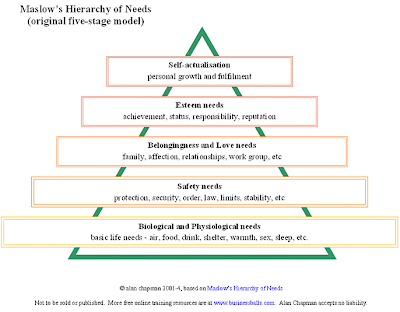
In my current job I have mastered everything there is to learn. According to Business balls (1995-2009) the Maslow hierarchy of needs suggests that self actualisation is the highest form of motivation. In my case, there is nothing to climb, and no new things to achieve. Therefore there is little motivation.
I have actually kept motivated by aspects from Herzberg’s Two Factor Theory. Tutor 2 u (2009) explains that I stay satisfied with my job due to hygiene factors, such as my relationship with my employers and team. It also suggests that my main motivational factor is gaining recognition of my high experience level. I get this recognition through requests to show new staff basic routines.
In employment future, if I were to apply to larger businesses, such as Marks and Spencer or John Lewis, climbing would be possible possible.
To Conclude,
I have found that I require the option of new opportunities. Without them, I find it difficult to feel that what I am doing has a purpose. It is the purpose that motivates me in what I do.
Reference list:
Valued based management (2009) EGR theory [online]. Available from: http://www.valuebasedmanagement.net/methods_alderfer_erg_theory.html [Accessed 13 October 2009].
Theories of motivation (2009) Overview [online]. Available from: http://www.analytictech.com/mb021/motivation.htm [Accessed 13 October 2009]
Business balls (1995-2009) Maslow's hierarchy of needs [online]. Available from: http://www.businessballs.com/maslow.htm [Accessed 13 October 2009]
Tutor 2 u (2009) Herzberg two factor theory [online]. Available from: http://tutor2u.net/business/people/motivation_theory_herzberg.asp [Accessed 13 October 2009]

I feel that Alderfer’s ERG theory is my most relevant content theory on motivation.
Valued based management (2009) suggests that a lack of higher level needs may cause a regression to lower level needs, which appear easier to satisfy. This applies to me, as I am bored by a lack of new challenges, for example when you’ve pulled one pint successfully, you can pull a million the same way. Therefore, I will find new pastimes, such as cleaning duties, to keep myself busy.
Alderfer’s ERG theory explains the importance of growth needs. It understands that people will work harder to gain opportunities which are attractive to them.
What Is My Motivation For Starting Business Management?
I have growth needs, and prefer to work in a close group environment. In any job I have done before, there have been no growth opportunities. My desire to achieve a degree can be explain using this basic perspective on motivation diagram:

In the near future there will be a NEED for me to become a reliable bread winner. Therefore, I’m DRIVEN (my behaviour) to gain the skills that I will need to get a job that will make enough money to support myself and my family.
I know that a SATISFACTORY job will be one where I can work with a team and gain high status; therefore a management course is desirable.
When Have I Felt De-motivated?

In my current job I have mastered everything there is to learn. According to Business balls (1995-2009) the Maslow hierarchy of needs suggests that self actualisation is the highest form of motivation. In my case, there is nothing to climb, and no new things to achieve. Therefore there is little motivation.
I have actually kept motivated by aspects from Herzberg’s Two Factor Theory. Tutor 2 u (2009) explains that I stay satisfied with my job due to hygiene factors, such as my relationship with my employers and team. It also suggests that my main motivational factor is gaining recognition of my high experience level. I get this recognition through requests to show new staff basic routines.
In employment future, if I were to apply to larger businesses, such as Marks and Spencer or John Lewis, climbing would be possible possible.
To Conclude,
I have found that I require the option of new opportunities. Without them, I find it difficult to feel that what I am doing has a purpose. It is the purpose that motivates me in what I do.
Reference list:
Valued based management (2009) EGR theory [online]. Available from: http://www.valuebasedmanagement.net/methods_alderfer_erg_theory.html [Accessed 13 October 2009].
Theories of motivation (2009) Overview [online]. Available from: http://www.analytictech.com/mb021/motivation.htm [Accessed 13 October 2009]
Business balls (1995-2009) Maslow's hierarchy of needs [online]. Available from: http://www.businessballs.com/maslow.htm [Accessed 13 October 2009]
Tutor 2 u (2009) Herzberg two factor theory [online]. Available from: http://tutor2u.net/business/people/motivation_theory_herzberg.asp [Accessed 13 October 2009]
Subscribe to:
Posts (Atom)
